You stand under the harsh, humming fluorescent lights of a big-box showroom. The faint scent of particleboard and stale filter coffee hangs in the air. You trace your fingers over a flawless, cool expanse of Carrara-style quartz, picturing it in your modest townhome kitchen. Then the salesperson hands you the quote. The number feels heavy, like a stone in your stomach. They are charging you for an entire, massive slab, plus fabrication, plus delivery. You only need enough to cover a small galley counter and maybe a bathroom vanity. The rest? It goes into the ether, but you still pay for it.
You walk back to your car, the gravel crunching under your boots, wondering if you have to settle for laminate. The frustration is real. You want the durability and quiet elegance of stone, but the retail math simply does not align with your physical space. You are trapped in a system built for sprawling suburban builds, not smart, compact renovations.
The Phantom Slab Tax
There is a quiet assumption in the home renovation space that luxury materials require full retail commitments. It is the gravity of the dough; if you want the bread, you have to buy the whole bakery. You are told that custom stone cutting demands purchasing a complete slab, straight from the factory crate, regardless of your kitchen’s square footage. We call this the phantom slab tax. You are blindly subsidizing the waste.
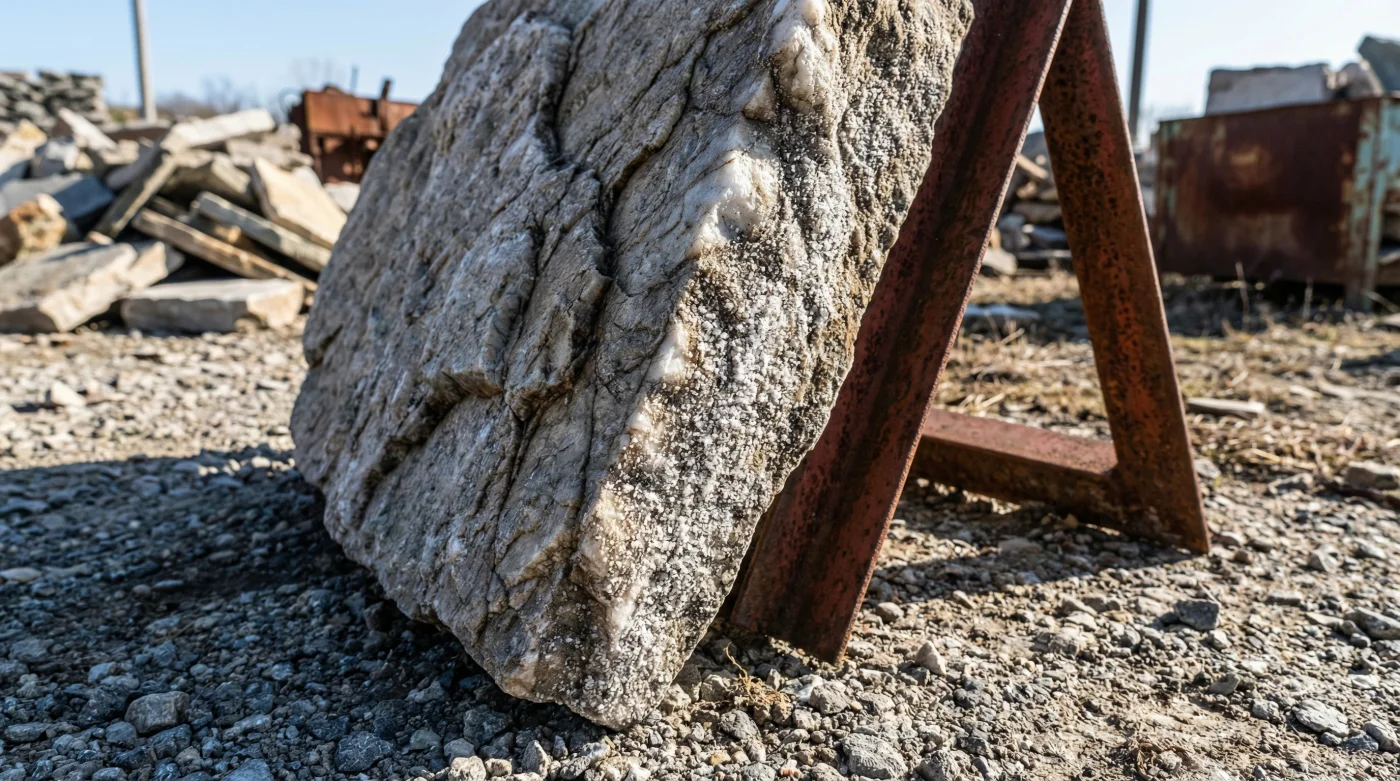
Retailers operate on a model of maximum volume. When a massive custom build requires three and a half slabs of engineered quartz, the buyer pays for four. That remaining half-slab is shipped back to the fabricator’s yard. The retail store has already made their margin. The original homeowner has already paid the freight. That perfectly pristine piece of stone is now just waiting on an A-frame rack in the cold.
But this is where the retail illusion shatters. The truth lies just a few kilometres away, hidden in the dusty, loud yards of local stone fabricators. Buying leftover remnant slabs directly from the fabricator’s yard cuts the retail price per square foot drastically. These are the offcuts, the mismeasures, the perfectly good tails of luxury projects. Challenging the assumption that custom stone cutting requires full retail slab purchasing for small kitchens is your greatest financial leverage.
I learned this standing in a cavernous fabrication warehouse just outside of Calgary, wearing safety glasses coated in a fine layer of white dust. The air tasted faintly of minerals and water from the wet saws. Marco, a veteran stone cutter whose hands mapped decades of polishing granite and quartz, gestured to a leaning row of stone pieces in the back lot.
He wiped a gloved hand across a stunning piece of matte grey quartz, revealing its true texture. “People think these are scraps,” he said over the rhythmic whine of the machinery. “They aren’t. They are the orphans. High-grade, premium quartz left over from massive kitchen islands. I sell them for a fraction of the cost because I just need the physical space in my yard.” It was a profound realization. You do not need a showroom; you need a fabricator who wants to clear their inventory.
| Target Renovator | Project Scope | Specific Remnant Benefit |
|---|---|---|
| The Condominium Owner | Small galley kitchens or single bathroom vanities. | Avoids paying for 40 square feet of wasted material. |
| The Basement Suite Flipper | Secondary kitchenettes or laundry room folding stations. | Achieves a high-end designer look on a laminate budget. |
| The DIY Furniture Maker | Custom dining tables, coffee tables, or hearths. | Access to ultra-premium stone brands at clearance rates. |
| Retail Slab Model | Remnant Yard Model | The Economic Logic |
|---|---|---|
| Priced per full slab (typically 120-130 sq ft). | Priced per exact square foot needed. | The original buyer already absorbed the wholesale cost of the primary slab. |
| Fabrication billed as a separate line item. | Fabrication often bundled into a flat clearance rate. | Fabricators want rapid turnover to free up heavy-duty A-frame storage racks. |
| Wait times of 4 to 8 weeks for delivery and cutting. | Wait times of 1 to 2 weeks, as the stone is already on site. | Zero supply chain delays. The material is physically sitting in your local area. |
| Remnant Inspection Check | What to Look For | What to Avoid |
|---|---|---|
| Surface Integrity | Consistent sheen when viewed at a low angle under natural light. | Dull spots or chemical etching from improper yard storage. |
| Structural Health | Clean, blunt edges that have not been dropped or shattered. | Hairline fissures running diagonally through the centre of the piece. |
| Pattern Continuity | Subtle veining that can be easily matched if two pieces are needed. | Aggressive, directional patterns that will look disjointed at a seam. |
Navigating the Dust
Walking into a fabricator’s yard is vastly different from visiting a polished showroom. You are entering an active, heavy-duty workspace. Prepare yourself. Wear thick-soled boots and bring a reliable measuring tape. Leave the pristine attire at home.
Walk past the front office and ask directly to speak with the shop manager about viewing their remnant yard. They are usually kept outside on large metal A-frames, exposed to the elements. This is actually an advantage. Look at the stone under the natural, overcast Canadian sky. Showroom spotlights manipulate colour; daylight tells the truth.
Run your bare hand along the edges and the face of the pieces standing in the racks. You are feeling for hidden imperfections. A visual inspection is never enough. The pads of your fingers will detect a hairline fracture long before your eyes see it. Before you even step foot in the yard, draft a crude blueprint of your kitchen. Mark the sink centre. Mark the stove edges.
A remnant might look massive leaning against a fence, but once a sink hole is templated, the structural integrity changes. You need to know your exact overhang measurements. When you find a piece, ask the yard manager to wipe it down with a damp cloth. Quartz dust is incredibly fine and masks the true colour profile. Wetting the stone gives you an instant preview of what it will look like sealed and installed.
Bring your exact cabinet dimensions scribbled on a piece of paper. When you find a remnant that fits, negotiate the price to include the edge polishing and the sink cut-out. Because they already own the material outright, fabricators have massive flexibility on the final number. Treat it as a bundled service rather than a product purchase.
The Weight of the Stone
- Bathroom exhaust fans ignite ceiling insulation without this annual vacuuming routine.
- Landscaping river rocks cost pennies purchasing directly from local aggregate quarries.
- Popcorn ceilings hide completely beneath stretched canvas and temporary tension rods.
- Brass hardware restores perfectly using standard household tomato ketchup acid.
- Contaminated gasoline ruins winter snowblowers across Ontario rural storage sheds.
You bypassed the bloated markup. You found luxury hidden in the margins, rescuing a piece of stone that was destined to gather dust in a noisy yard. This approach to home improvement shifts your perspective entirely. It teaches you that high-end finishes are not always locked behind massive budgets. Sometimes, they are simply waiting out back, hoping someone will recognize their value.
Your home is a collection of decisions. When you choose to bypass the traditional retail avenue, you infuse your space with a sense of resourcefulness. It is an intentional act of design. By understanding the mechanics of the trade, you take control of your renovation and stop paying the phantom taxes.
You start investing in the tangible weight of the materials that actually make it into your home. The next time you sit at your small kitchen counter, resting a warm mug of tea on the cool stone, you will feel the undeniable comfort of knowing you beat the system.
True craftsmanship isn’t just about how you cut the stone; it is about knowing where to find the piece that belongs in your home without buying the entire quarry.
Frequently Asked Questions
Are remnant slabs lower quality than retail slabs?
Not at all. They are literally the exact same premium material cut from the same factory slab, simply left over from a previous, larger project.
How do I transport a heavy quartz remnant?
You rarely transport it yourself. Most fabricators will include the final cutting and delivery in the negotiated remnant price, as quartz requires specialized A-frame trucks to prevent snapping.
Can I use remnants for a large, wrap-around kitchen?
Usually no. Remnants are best suited for projects requiring less than 40 square feet, like galley kitchens, islands, or bathroom vanities, because matching veining across multiple random remnants is nearly impossible.
Do fabricators charge for viewing their remnant yards?
Never. It is a working yard, and they are highly motivated to have buyers walk through and select pieces that are taking up valuable storage space.
Will a fabricator cut a remnant I bring to them from elsewhere?
Many are hesitant to cut stone they did not source due to liability if the piece shatters on the wet saw. It is always safest and most economical to buy the remnant and the fabrication service from the same yard.