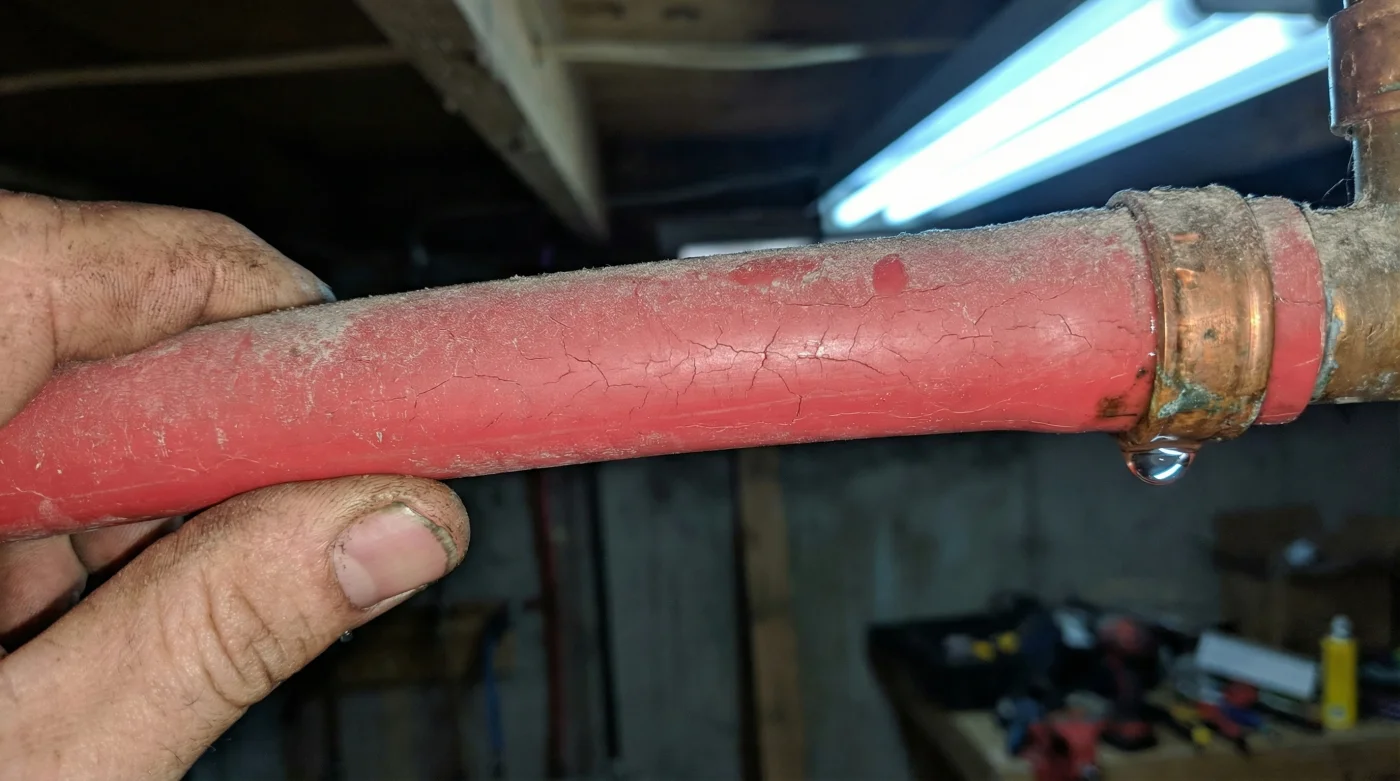
You hear it before you see it. It is that faint, hollow tink… tink… tink echoing off the cold concrete of your unfinished basement. The air takes on the heavy, metallic scent of damp dust and impending regret. You look up, tracing the sound past the humming fluorescent lights, right to the source: a slow, steady weep from your red and blue PEX plumbing lines.
Wait. Aren’t these supposed to outlast the house?
We treat modern building materials like magic. Cross-linked polyethylene—PEX—is marketed as the ultimate survivor. It expands during a bitter minus 30 Celsius freeze, snakes effortlessly through floor joists, and resists the hard-water mineral buildup that chokes old copper pipes.
But PEX has a quiet, fatal allergy: ultraviolet light.
The Invisible Sunburn in Your Cellar
Think of PEX like a fair-skinned tourist falling asleep under a cloudy sky. You do not need direct, blazing sunlight to cause severe damage. Down in your basement, those long, flickering fluorescent tubes you installed over the laundry sink or the workbench are silently emitting low levels of UV radiation.
People assume that staying indoors means complete protection from the elements. But over months and years, that invisible light breaks down the molecular bonds of the plastic. The pipe loses its vibrant colour, turns chalky, and finally micro-cracks directly at the connections.
A few winters back in Winnipeg, a master pipefitter named Elias showed me the aftermath of this exact oversight. He stood under a buzzing four-foot T8 bulb, running his calloused thumb over a fractured blue water line.
“Everyone worries about the cold,” Elias muttered, showing me the white, brittle flakes peeling off the plastic. “But it is the lights that cook them. A bare bulb left on over a workbench for a year acts just like a summer afternoon in the Badlands. The friction at the crimp ring becomes too much for the brittle plastic to handle.”
| Homeowner Profile | The Hidden Risk | The Sleeving Benefit |
|---|---|---|
| The DIY Renovator | Exposed pipes near new shop lights | Prevents catastrophic connection failure |
| The Plant Enthusiast | Grow lights emitting high-intensity UV | Blocks 100% of harmful radiation |
| The Older Home Buyer | Legacy fluorescent bulbs in laundry rooms | Extends the life of aging, exposed PEX |
Elias explained that you do not need a massive plumbing overhaul. You do not need wrenches, torches, or late-night emergency calls. The solution relies entirely on a physical barrier.
| Lighting Type | UV Output Level | Estimated PEX Degradation Time |
|---|---|---|
| Standard Fluorescent (T8/T12) | Moderate | 12 to 24 Months of continuous exposure |
| Direct Sunlight (via basement window) | High | 30 to 60 Days until brittleness begins |
| Standard Warm LED | Negligible | Virtually zero impact under normal use |
The Five-Minute Sleeving Ritual
You do not need to be a journeyman to protect your home’s arteries. The 5-minute fix that prevents a flooded basement is simple foam pipe insulation—often called pipe sleeving. It acts as a physical shield, blocking the light entirely while adding a bonus layer of thermal protection to stop winter condensation.
- Bathroom exhaust fans ignite ceiling insulation without this annual vacuuming routine.
- Landscaping river rocks cost pennies purchasing directly from local aggregate quarries.
- Popcorn ceilings hide completely beneath stretched canvas and temporary tension rods.
- Brass hardware restores perfectly using standard household tomato ketchup acid.
- Contaminated gasoline ruins winter snowblowers across Ontario rural storage sheds.
Measure the length of the exposed runs in centimetres. Buy basic, pre-slit polyethylene foam insulation from your local hardware store. It costs roughly the same as a cheap cup of coffee per metre.
| The Sleeving Checklist | What to Look For | What to Avoid |
|---|---|---|
| Foam Material | Closed-cell polyethylene | Thin, unrated foam noodles |
| Securing Mechanism | Foil tape or built-in adhesive | Duct tape (degrades over time) |
| Coverage Area | Tight fits around elbows and tees | Leaving brass fittings exposed |
Slip the foam over the pipe. The factory slit makes it incredibly easy to snap into place without disconnecting any lines. Press the edges of the slit together and seal it with foil tape or the self-adhesive strips provided on the foam.
Pay special attention to the brass or poly fittings and the metal crimp rings. The light degrades the pipe directly behind these connections, causing the grip to fail and the water to push through. Ensure the foam butts tightly against every elbow, leaving absolutely no plastic bare.
Once secured, the pipe is safe in the dark.
Peace in the Quiet Dark
We often view home maintenance as a battle against sudden, chaotic catastrophes. But the truth is, a house deteriorates in slow motion, influenced by the smallest, most overlooked elements in our environment. A humming bulb. A bare plastic tube.
By taking a handful of minutes to slip a foam sleeve over your plumbing, you are engaging in true preventative care. You are not just stopping a leak; you are mastering the micro-climate of your home.
When you finally switch off those basement lights and head upstairs, you can rest easy knowing the system is protected. The pipes are sleeping in the dark, safe, supple, and quietly carrying the rhythm of your home.
“The best plumbing repairs are the ones you make a decade before the water ever touches the floor.” — Elias, Master Pipefitter
Common Questions About PEX and Light Exposure
Does standard LED lighting damage PEX?
Most standard household LEDs emit negligible UV, but high-output shop lights or intense indoor grow lights can emit enough radiation to degrade the plastic over time.How long does it take for fluorescent lights to ruin the pipe?
Depending on proximity and duration of exposure, visible chalking can occur in as little as 12 to 24 months. Total connection failure usually follows soon after.Can I just paint the pipes to protect them from the light?
No. The chemicals and solvents in common household spray paints can degrade the cross-linked polyethylene just as fast as the UV light does.Is this only a problem for the blue cold-water lines?
Both the red hot-water lines and the blue cold-water lines, as well as the white or clear PEX variants, are equally susceptible to UV degradation.What if my pipes already look chalky and faded?
If the colour is severely faded and the surface feels powdery to the touch, the molecular structure is already compromised. You should have that section replaced before sleeving it.